SCOVILL'S
INSTANTANEOUS LENS AND SHUTTER
American Optical Company/Scovill
& Adams Company 1891 - 1893
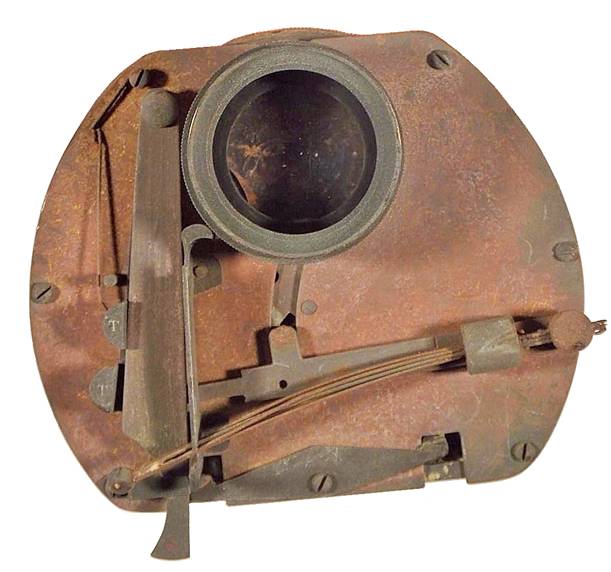
Scovill's
Instantaneous Lens and Shutter, manual version
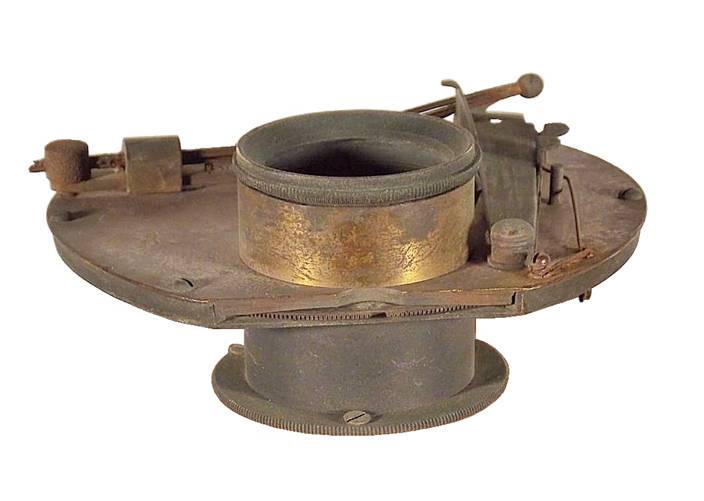
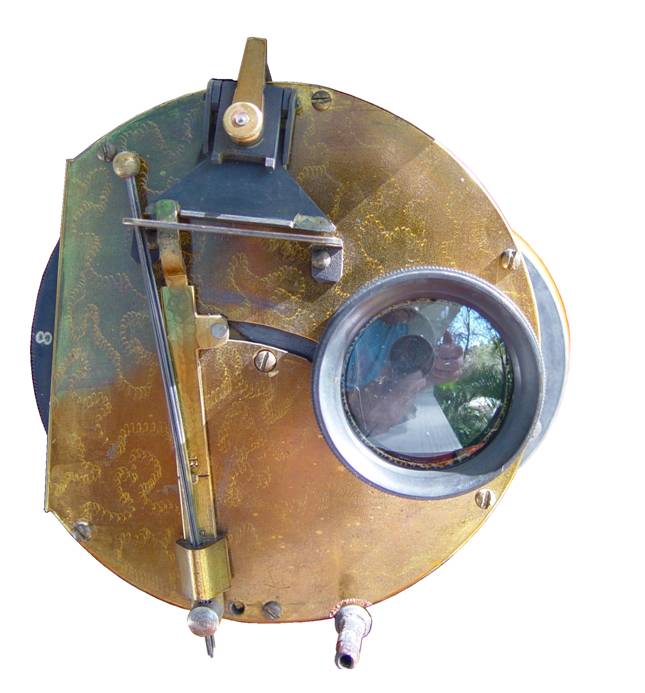
Scovill's
Instantaneous Lens and Shutter, pneumatic version, with a rounded casing edge
adjacent to the aperture and lens barrel versus the squared edge on the manual
model. Note the nipple at the base of
the shutter, and the pneumatic valve at the rear.
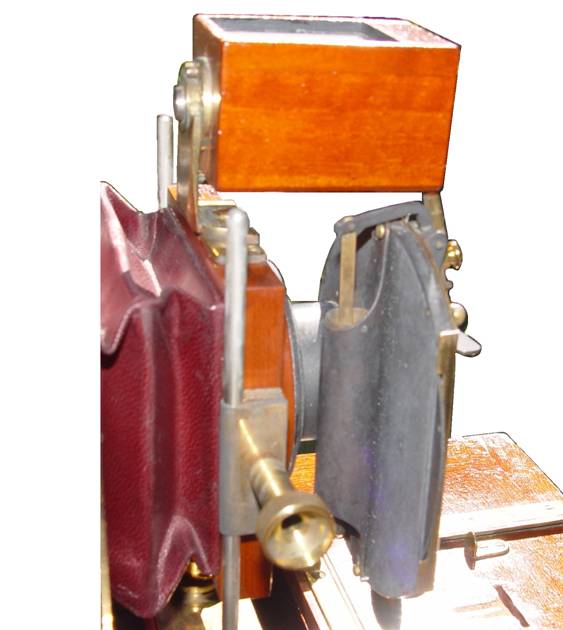
Scovill's
Instantaneous Lens and Shutter is believed to have made
its appearance on the Henry Clay Camera as early as June, 1891, and is seen in
catalogue engravings in the January, 1892, Scovill & Adams "How to Make Photographs and
Descriptive Price List".
Pending better information, its manufacture is being attributed to
American Optical Company/Scovill & Adams based upon the origination and
assignment of its design patent.
With its patent application having been filed on August
7, 1891 and its appearance by January, 1892, the shutter was being manufactured
at least three years prior to obtaining the patent. Designed by Washington Irving Adams of Montclair, New Jersey, President &
Treasurer of the Scovill & Adams Company of New York, Patent No. 536,253 was granted on March 26, 1895 and assigned to
Scovill & Adams. The shutter's
casing is very similar in shape to the Mathein (or Wale
& Mathein) Shutter, which was patented just
one month earlier on February 19, 1895, Patent
No. 534,337. Over the past forty
years, collectors have referred to the Mathein as a "Wale Shutter". This
is somewhat correct, in that the shutter's design was patented by Franz J. Mathein and the lenses are
believed to have been made by George
Wale. The firm of Wale & Mathein, Marksboro, New
Jersey, produced the finished product and some shutters found today are marked
"Wale & Mathein", while others have no markings.
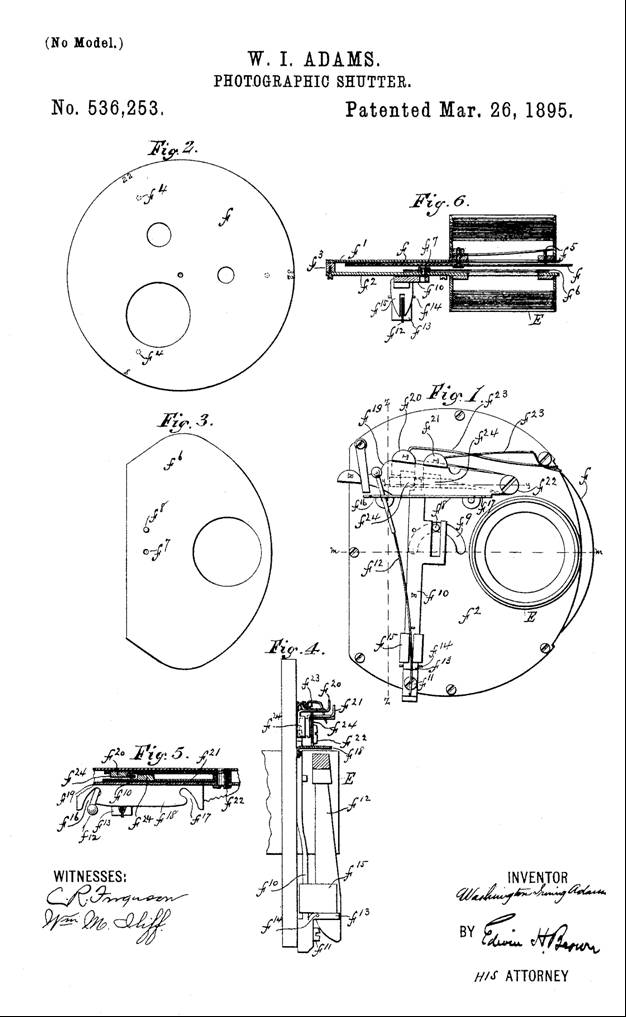
Patent for Scovill's
Instantaneous Lens and Shutter
Source: Google Patents
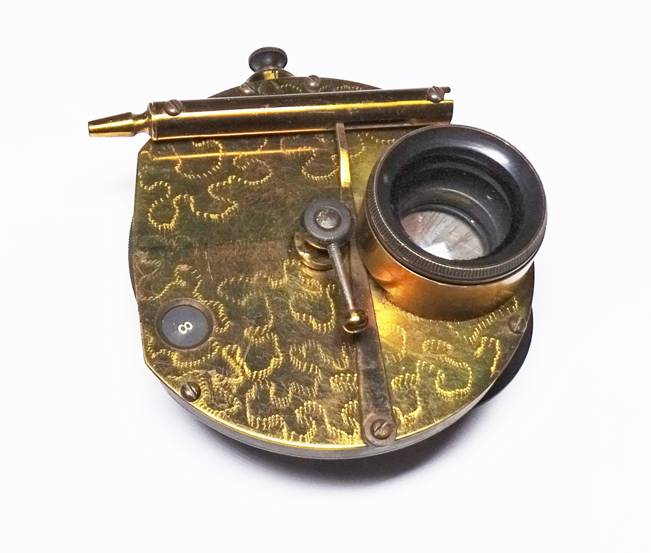
Unmarked Mathein Shutter
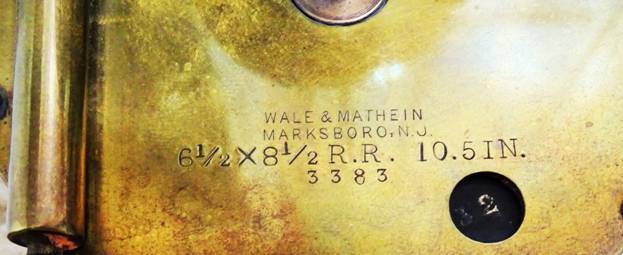
Mathein Shutter
having the manufacturer's name, format, lens type (R.R. for Rapid Rectilinear),
focal length and serial number
Despite Scovill's Instantaneous Lens and Shutter being the
first shutter to be offered on the Henry Clay Camera, most Henry Clays
(sliding-bed or hinged-bed designs) are seen today with the Mathein
Shutter. Like Washington Irving Adams'
Patent, Mathein's Patent was also assigned to Scovill & Adams.
Similarities in design, the timing of patents and their
assignment to Scovill & Adams, might suggest some connection between all
these parties. What has been reflected through
advertisements, is that early models of the Henry Clay were equipped with
Scovill's Instantaneous Lens and Shutter, mid-production models with the Wale
& Mathein and Bausch & Lomb's Iris Diaphragm or Unicum
during the last three years of production through 1899. Although not
specifically mentioned in the description, the Henry Clay's engraving from
Scovill's 1899 catalogue suggests that in standard form, it came equipped with
a Unicum Shutter.
It's interesting to note that Bausch & Lomb's Iris
Diaphragm Shutter was available by at least May, 1891 in E. & H.T.
Anthony's catalogues concurrent with the Henry Clay's introduction about June,
1891. So, why didn't Scovill & Adams
use the Iris Diaphragm early on? Even though the Iris Diaphragm would
ultimately gain a solid reputation for its technology, simplicity and
performance, it had yet to earn it. Perhaps
it was an effort by Scovill & Adams to keep as much of their product
in-house, with both patents for Scovill's Instantaneous Lens and Shutter and
the Mathein Shutter being owned by them.
By October, 1893, Scovill's Instantaneous Lens and
Shutter was being billed as the "Instantaneous Lens and Plain
Shutter" for the Henry Clay, and could be had with a pneumatic release for
$5.00 extra:
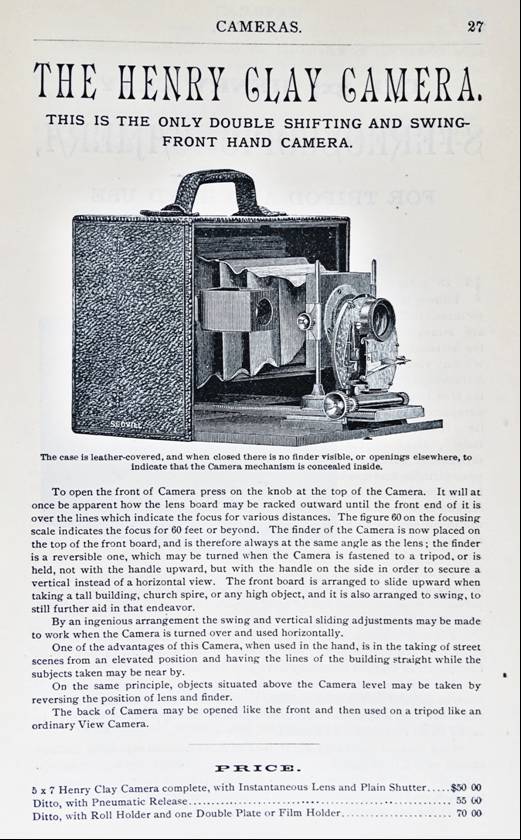
Ad from Scovill & Adams' How to Make
Photographs, October, 1893
Since the Instantaneous Lens and Shutter wasn't designed
with a pneumatic release, and that by 1893 the Wale & Mathein's patent was
filed with a design incorporating a pneumatic release, maybe the Henry Clay
engraving showing the Instantaneous Lens and Shutter had not yet been upgraded
to reflect the new Mathein design. This could explain the availability in 1893
of a pneumatic release, a feature on the Wale & Mathein that was probably
being manufactured by that time. For 1894 and 1895, the Mathein
Shutter's engraving was finally depicted in Henry Clay advertisements,
continuing to be billed as the "Instantaneous Lens and Plain Shutter"
with a pneumatic release for $5.00 extra. By 1896, the Mathein
was billed as the "New Safety Shutter", shown in a smaller 4x5 size
on the Henry Clay 2nd model.
This example of Scovill's Instantaneous Lens and Shutter
(non-pneumatic) measures approximately 3-7/8" at its widest point, by
3-1/4" at its shallowest width with a lens barrel diameter of 1-3/8". The shutter and lens barrel are devoid of any
maker's name, numbers or other markings.
Despite its worn exterior, like the Scovill's Instantaneous Lens and
Shutter pneumatic version above, this manual version is constructed with a
brass face and exhibits the remnants of a lacquered finish and a scarified-line
pattern.
The Instantaneous Lens and Shutter was only shown in
advertisements as being available on the Henry Clay Camera, and appears to have
never been offered as a separate item in Scovill & Adams' catalogues. No other references or ads for the shutter
have been found. Only a handful (both
manual and pneumatic versions combined), are known to exist in private collections,
with at least one known example in the George Eastman Museum's Technology
Collection.
With relatively few having been manufactured for about
two or three years, and the few surviving today, Scovill's Instantaneous Lens and Shutter is an exceedingly rare
American shutter.
SIDE
STORY
The
non-pneumatic version of Scovill's Instantaneous Lens and Shutter shown above,
was found on eBay, billed as a Prosch Duplex.
I had previously come across the patent for the shutter and placed it on
my log with a reference to it being "Mathein-like" in appearance.
Having no idea this patent was for Scovill's Instantaneous
Lens and Shutter, and not having really looked closely at early Henry Clay ads,
I dismissed the shutter depicted in those engravings as being a Wale &
Mathein based upon its similar shape. It
was quite exciting to discover this new shutter that I had never seen before,
which in reality was an old shutter I had seen many times before.